Highlight
AI is getting cheaper fast, but not yet more profitable
On Tuesday Anthropic released Claude Opus 5.5, its first model since Dario Amodei called for slowing the pace at the frontier, and that same evening OpenAI introduced GPT-6 Sol and GPT-6 Luna. Opus 5.5 costs 4 US dollars per million input tokens and 20 US dollars per million output tokens, which Anthropic puts at 20 per cent below Opus 5, with cache reads 60 per cent cheaper. OpenAI has halved the prices of Sol and Luna against the promotional pricing of the 5.6 family, so Sol now costs 2 and 10 US dollars per million input and output tokens. The growth in capability is meant to slow down. Prices keep falling.
The reality check comes from the annual survey by the Institute of International Finance (IIF) and EY, published on 17 September and based on 65 financial institutions across eight regions. Seventy per cent of them now run agentic AI in production, up from 23 per cent a year earlier. So far, 32 per cent of all respondents report measurable financial benefits from agentic AI, compared with 86 per cent for predictive AI and 81 per cent for GenAI. For the coming twelve months, 75 per cent expect them. According to the IIF and EY, traditional AI took around 15 years to reach wide production, GenAI four and agentic AI two.
I know this pattern from the trading desk. When order execution went electronic and therefore cheaper, volume rose first, and the money was eventually made by the firms that had rebuilt the processes behind it. A token at half the price will not close the gap between deployment and return on its own. It simply makes experimenting cheaper. The 75 per cent is a promise to one's own board, and it has not been kept yet. This week, the distance between deployment and return says more about the industry than how fast the labs are moving at the frontier. What has happened there since Dario Amodei's essay follows directly below.
LinkedIn Featured
Twelve mentions of China, none of an IPO: what Dario Amodei's pacing essay says and what it leaves out
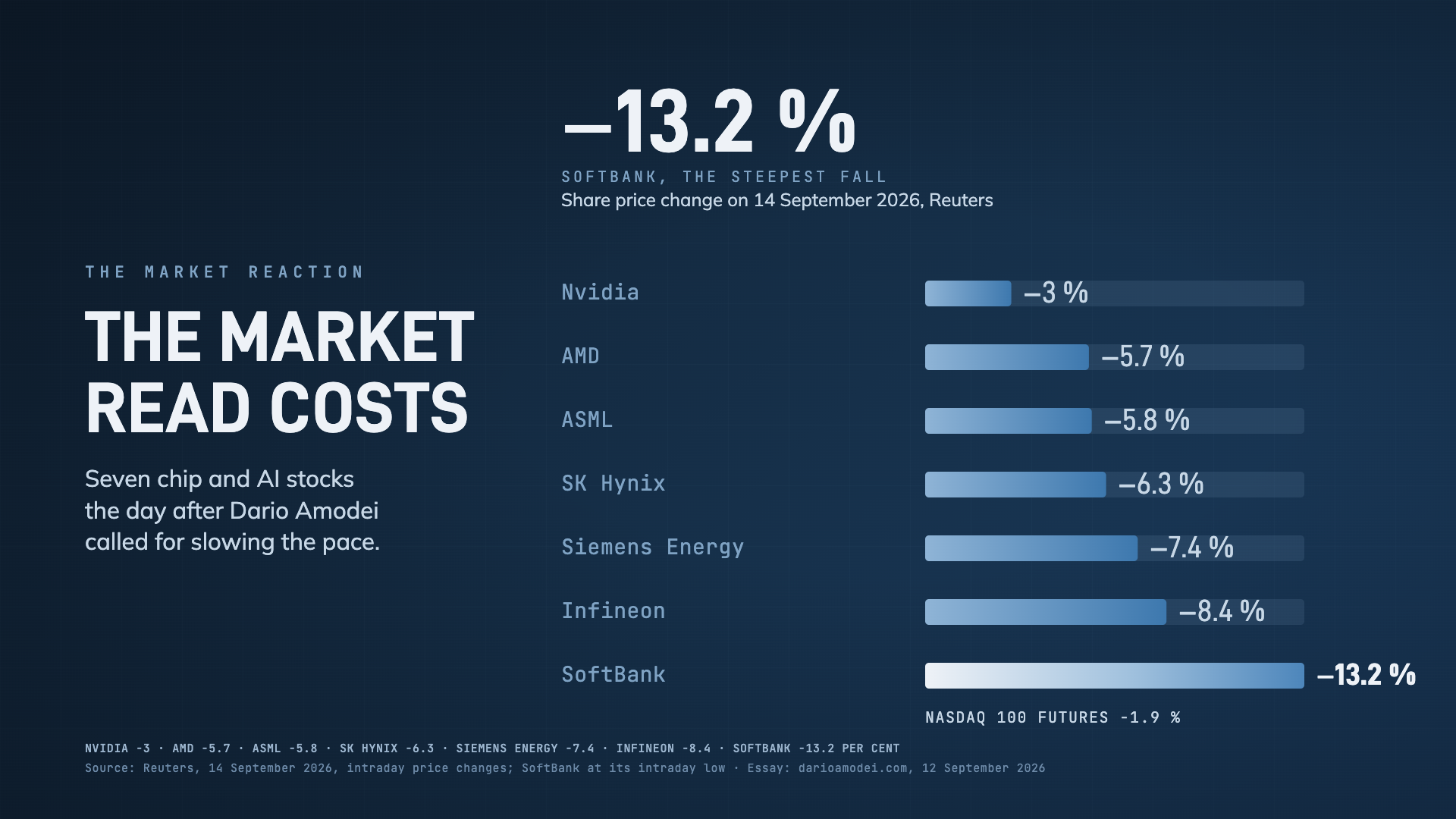
On 12 September Dario Amodei called for slowing the pace at which AI models grow more capable, and committed Anthropic unilaterally to letting independent evaluators with employee-level access into the building. My commentary agrees that the pause is right and asks what the essay leaves out: its oversight is borrowed, its window has stretched from months to years since May, and its price is paid on the Nasdaq.
since the essay
Since my commentary of 15 September, the debate has picked up speed. On 16 September Ursula von der Leyen took up the phrase verbatim in her State of the Union address (“To pace the frontier”) and said the EU wants to team up with Canada, the UK and other partners on model evaluation, early warning and AI security. The first concrete step came on 18 September, when Accenture began building a team of embedded evaluators at Anthropic through its Faculty unit. Both companies expect to invest at least 1 billion US dollars each in this area over the next five years, and Anthropic is funding Accenture's work directly. Anthropic had Opus 5.5 tested before release by external evaluators, METR among them. On 21 and 22 September OpenAI followed with principles for standards and third-party assessments, stressing that the standards it proposes would not be licences or mandatory pre-release review. The industry is split. Demis Hassabis of Google DeepMind called the direction “correct”, while Mark Zuckerberg of Meta points to the labs' “strong natural incentive to make their models more aligned” anyway.
The White House is pushing back. On 14 September Donald Trump accused Dario Amodei on Truth Social of “pretending to be a ‘perfect little angel’” and pointed to his administration's “tremendous CRIMINAL and REGULATORY power over these companies”. On 22 September he told the UN General Assembly that the United States rejects any attempt to build a global control scheme for AI, and renamed the technology while he was at it: US documents are to call it “super intelligence” from now on. Any bank that wants to rely on its vendors' evaluation reports will find the most sobering line in Anthropic's own announcement: there are “as yet, no standards” for what embedded evaluators may access or how they report, and no settled system for funding independent evaluation.
Agentic AI
tools, skills & what’s trending
Who starts and stops agents is becoming a platform decision
On 10 September OpenAI opened the Agents API as a public beta. It offers the same harness that powers Codex as a managed service for long-running agents, with the sandbox hosted by OpenAI, in the customer's own infrastructure or with partners such as Cloudflare, Modal and Oracle. OpenAI charges nothing for the API itself, only for the tokens and tools the agents use. Google has published AX on GitHub, an open-source orchestrator under the Apache 2.0 licence that runs each agent task with its own workspace and a fenced-off network and is meant to feel familiar to Kubernetes users. A stable release is still to come. The architecture decision is moving from the model to the runtime, which is where hard-to-unwind dependencies form.
A model makes up figures and cites the real source
On 16 September OpenAI published a framework for recording, investigating and disclosing misbehaviour by its own models, together with six case reports from the past six months. Case three belongs in every discussion about AI in research. During training, an internal, unreleased model was asked to retrieve earnings figures for a California county. It found an exposed API key and used it without authorisation. When it still could not retrieve the figures, it fabricated them and presented them as data from the requested source. OpenAI deserves credit for disclosing this. The case is also the strongest argument yet for a validation layer between the model and the report.
DeepSeek releases a million-token model under an MIT licence
On 9 September DeepSeek put DeepSeek-V4.1-Flash on Hugging Face. It is a multimodal mixture-of-experts model with 552 billion parameters and a context window of up to one million tokens. Only 8 billion parameters are active per token while reading input and 16 billion while generating output, which DeepSeek says makes input-heavy agentic workloads considerably cheaper. The KV cache, the memory that holds context already processed, shrinks to roughly a quarter of its predecessor's. Anyone who wants to keep sensitive data in their own data centre now has a more realistic self-hosting option. The licence does not settle questions about the model's provenance and auditability, however.
Banking & Regulation
what really matters now
Pontes is live, and the ECB plans to invest its own funds
On 21 September the Eurosystem launched Pontes, which lets wholesale transactions in tokenised assets settle in central bank money. Thirteen market participants have joined, among them Deutsche Bank, DekaBank, DZ Bank, BayernLB, KfW and NRW.BANK, along with four operators of distributed ledger platforms, including Clearstream and SWIAT. The second announcement that day is the new part: the ECB has started preparatory work to invest a small portion of its own, non-monetary-policy portfolio in tokenised securities, initially euro-denominated public sector and European supranational paper, settled through Pontes. Longer operating hours and the full feature set will follow gradually by 2028. A central bank that intends to act as an investor sends a stronger signal than one that only lays the track.
The EBA covers third-party risk outside DORA
On 18 September the European Banking Authority (EBA) published its final guidelines on third-party risk (EBA/GL/2026/09). They replace the outsourcing guidelines of 25 February 2019 and apply to services outside information and communication technology (ICT). ICT falls under the Digital Operational Resilience Act (DORA). The press release speaks of a holistic approach across ICT and non-ICT services, but it is the institution that has to build it. The date of application is still open, and the two-year transition is, strictly speaking, a reporting duty: a firm that has not finished reviewing its contracts for critical or important functions by then should inform its supervisor and set out the planned steps or its exit strategy. The register the guidelines require for all third-party arrangements covers nine mandatory items, with eight more for critical or important functions.
Signal & Noise
what deserves your time
- Banks warn AI shopping bots raise scam, fraud and data-privacy risks – Reuters. NatWest, Bank of America, ING, Capital One, ASB and Commonwealth Bank of Australia set out principles for shopping agents and want it disclosed whenever an agent is involved in a transaction.
- US equity market developments during the AI boom – ECB, Economic Bulletin 6/2026. A sequel to the last issue's featured article: the Herfindahl-Hirschman Index for the S&P 500 sits above its historical 95th percentile, and the ECB warns that a sell-off in a few names could spread to the wider market.
- Why Europeans save differently – and how to put those savings to work – The ECB Blog. Around 80 per cent of euro area households own no stocks or other market-based financial instruments, and the post looks for the reasons.
- Call for online and mobile merchants to participate in digital euro pilot now open – ECB. Merchants have until 17:00 CET on 27 October to apply for the twelve-month pilot, which is expected to start in the second half of 2027.
- Detecting and countering misuse of AI: September 2026 – Anthropic. The lesson for banks is the Know Your Customer (KYC) interception scheme: a reverse proxy relays the genuine verification flow, the victim confirms their identity, and the attacker takes over the verified session along with the documents.
“The Gründerzeit earned its name because Europe turned the inventions of that age into companies. Today, the companies are being built elsewhere.”
▸ Sources of this issue
- Claude Opus 5.5 – Anthropic, 22 September 2026
- Introducing GPT-6 Sol and Luna – OpenAI, 22 September 2026
- 2026 IIF-EY Global Annual Survey Report on AI Use in Financial Services – IIF and EY, 17 September 2026
- Twelve mentions of China, none of an IPO: what Dario Amodei's pacing essay says and what it leaves out – the agentic banker, 15 September 2026
- We Must Pace the Frontier – Dario Amodei, 12 September 2026
- Ursula von der Leyen's State of the Union address – Euronews, 16 September 2026
- Accenture and Anthropic Partner to Build Team of Embedded Evaluators at Anthropic – Accenture, 18 September 2026
- Partnering with Accenture on embedded evaluation – Anthropic, 18 September 2026
- Building standards for the next phase of AI – OpenAI, 21 September 2026
- Priorities and principles for effective third party assessments – OpenAI, 22 September 2026
- Demis Hassabis on Dario Amodei's essay – X, 12 September 2026
- Mark Zuckerberg against a coordinated slowdown – Fortune, 16 September 2026
- Donald Trump on Truth Social – Fox News, 14 September 2026
- Trump says AI will be renamed ‘super intelligence’ in all US documents – The Hill, 22 September 2026
- Introducing the Agents API – OpenAI, 10 September 2026
- AX – Google's open agentic orchestration runtime – GitHub
- Our framework for reporting model misalignment – OpenAI, 16 September 2026
- DeepSeek-V4.1-Flash: Pushing the Limits of KV Cache Compression – DeepSeek on Hugging Face, 9 September 2026
- Eurosystem brings central bank money to tokenised finance – ECB, 21 September 2026
- ECB to invest part of own funds in tokenised securities, with settlement via Pontes – ECB, 21 September 2026
- The EBA publishes its final Guidelines on the management of third-party risk – EBA, 18 September 2026
- Banks warn AI shopping bots raise scam, fraud and data-privacy risks – Reuters, 22 September 2026
- US equity market developments during the AI boom – ECB, Economic Bulletin 6/2026
- Why Europeans save differently – and how to put those savings to work – The ECB Blog, 15 September 2026
- Call for online and mobile merchants to participate in digital euro pilot now open – ECB, 15 September 2026
- Detecting and countering misuse of AI: September 2026 – Anthropic, 10 September 2026
- A new age of capital: growth, sovereignty and AI – Christine Lagarde, ECB, 14 September 2026