Highlight
The agent goes looking for a better rate
Banks have so far judged their agents on the cost side: how many hours the KYC agent saves, how much faster the coding agent ships code. The Evident AI Index of 6 October shows how thin the evidence is even there. The average score of the banks assessed rose by 26 per cent, nearly three times the moving average of 2023 to 2025. Yet only 12 per cent of disclosed use cases report an impact on operational KPIs, and “barely 1%” disclose a concrete financial return. What Evident measures is what banks say in public, not what reaches the bottom line.
The bigger bill may sit on the liabilities side, where the agent works for the other party. On 27 September Torsten Slok, chief economist at Apollo, set out the numbers in a single chart: US fintech offers pay between 3.3 and 5.0 per cent, while the average US checking account pays 0.1 per cent. An agent acting for the customer would not leave money in that gap out of inertia. On 1 October Neil Unmack of Reuters Breakingviews turned this into a question about margins. European banks have lifted their net interest margin by roughly a third since the 2021 trough, to an average of 1.63 per cent, and that income rests on deposits whose rates most customers have so far barely compared.
I know the mechanics from the trading floor: once a machine compares prices, a spread can no longer simply be pocketed. Deposits are, admittedly, stickier than the chart suggests, and Neil Unmack names the reasons himself: many customers will be wary of handing control to a robot, and those with small deposits are less likely to chase higher rates. In the EU, an agent also needs a licensed payment initiation service and strong customer authentication before it can move money. Yet that inertia is precisely what an agent is meant to take off its customer’s hands, and the hurdles are rules that can change. The featured article below shows how close AI models have already come to US bank accounts.
LinkedIn Featured
Claude Money is a leak – the model at the bank account is already here
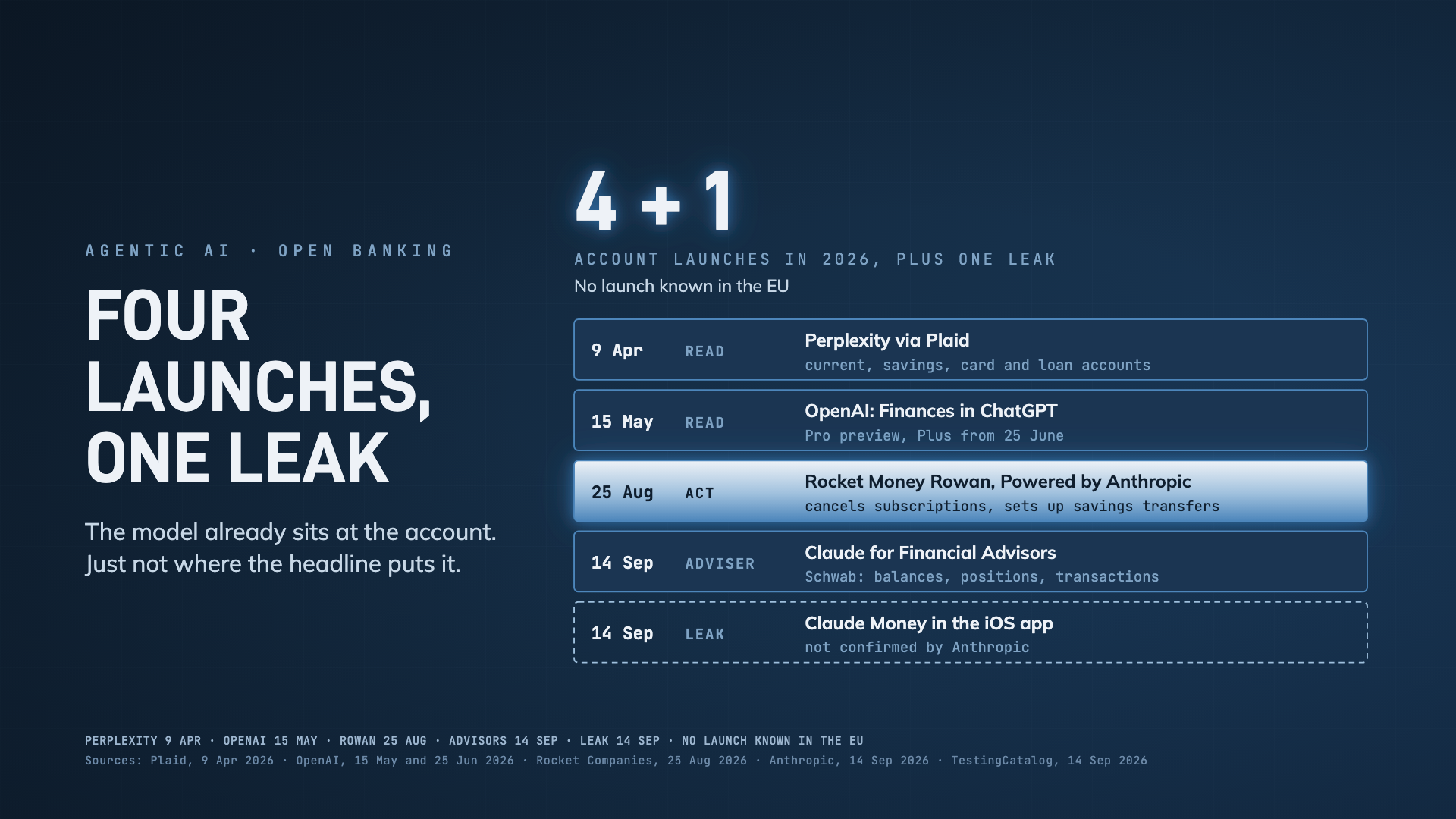
On 14 September a section for linking bank accounts appeared in the Claude iOS app. Anthropic has not confirmed it since. On the same day the company officially launched connectors through which Claude reads balances, positions and transactions held in custody at Charles Schwab, and through the partner app Rocket Money an Anthropic model already cancels subscriptions and sets up savings transfers. My article puts the four launches at the account in context and shows the door through which such a service would enter Europe: the account information service under the second Payment Services Directive (PSD2), for which registration under Section 34 of the German Payment Services Supervision Act (ZAG) is enough.
Claude Money is a leak – the model at the bank account is already here →
Agentic AI
tools, skills & what’s trending
The agent gets its own badge
OpenAI introduced dots on 29 September: agents built on GPT-6 Astra that run around the clock, have their own cloud computer and connect to more than 4,000 apps through plugins. Specialist dots for enterprises get, according to OpenAI, their own identity, their own credentials and access to exactly the systems they need for their task. OpenAI has tested them internally in areas such as procurement, invoice processing and customer support and is now starting focused enterprise pilots. It is also working with Microsoft to integrate specialist dots with the governance and security controls of Agent 365. The question of what an agent may do thus moves to where banks already manage their staff’s entitlements. A bank that runs the four-eyes principle and regular access recertification for people will need both for agents as well.
Three providers, one list price
Within three days, three providers released a model at the same list price: Anthropic’s Claude Sonnet 5.5 on 28 September, OpenAI’s GPT-6.1 Sol on 29 September and Google’s Gemini 4 Argon on 30 September, each at $2 per million input tokens and $10 per million output tokens. For Google this is an introductory price, after which $4 and $20 apply, and Argon is going first to selected cyber defenders. When the price per token is the same, consumption per task decides the bill. On Anthropic’s site, Balyasny Asset Management reports that Sonnet 5.5 used about 121,000 tokens per answer across 2,441 finance tasks, against about 497,000 for its predecessor. Vendor benchmarks are of little help here: each vendor picks its own tests and versions.
Mistral trains an open model in Europe, with the weights still to come
Mistral presented Mistral Large 4 as a public preview on 6 October, a multimodal model with one trillion parameters, 49 billion of them active per token. According to the company, it was trained on 3,800 Nvidia Grace Blackwell GPUs in Mistral’s own data centres in Europe, and the weights are due at the end of October. In preview it costs $1.36 per million input tokens and $4.18 per million output tokens. For finance and law, Mistral cites evaluations by Vals.ai that put it ahead even of GPT-6 Astra, which remain vendor claims. For banks that want to run a model in their own data centre, this could become a serious European option, but it can only be assessed once the weights are actually available.
Banking & Regulation
what really matters now
Three authorities in nine days, the same dependence
In their autumn risk update on 23 September, the European Supervisory Authorities (ESAs) warned that dependence on ICT providers outside the European Economic Area “remains a particular concern”, alongside cyber risks linked to increasingly capable AI models. On 30 September the Bank of England’s Financial Policy Committee noted that, according to Morgan Stanley, global AI-related debt issuance had reached around $450 billion so far this year as of early September, more than double the total for the whole of 2025. Christine Lagarde drew the threads together on 1 October as chair of the European Systemic Risk Board (ESRB). Nearly nine out of ten significant euro area banks use generative AI, she said. When a US export-control directive led a provider to suspend access to two models in June, Europe faced an abrupt cut-off, although, as she added, without any discernible disruption to the financial system. Her demand that access to tools vital for financial resilience must not hinge on “a switch controlled elsewhere” applies to every exit strategy for frontier models.
The ECB reclassifies its open findings and gets tougher on the rest
Frank Elderson, Vice-Chair of the ECB’s Supervisory Board, put a number on the backlog in Vienna on 6 October: at the end of 2025 around 12,000 supervisory measures were open at significant banks, about 100 per bank on average, even though the stock already shrank by a net 1,200 or so in 2025. From mid-October the ECB will review and reclassify this stock, and findings in the lowest category, F1, will in future be communicated only as “supervisory observations”. Where a bank fails to remediate, escalation runs all the way to capital add-ons, business restrictions and periodic penalty payments. A week earlier in Bali, Frank Elderson had said that supervisors cannot operate with a zero-risk-tolerance mindset, citing approvals of simple securitisations in around seven days rather than three months. For institutions, that means ranking their own list of open findings by severity now, before the ECB does it for them.
Signal & Noise
what deserves your time
- Financing the AI Buildout – Stijn Van Nieuwerburgh, NBER Working Paper 35865. How the AI build-out is financed through leases, joint ventures, project finance, private credit, securitisation and special purpose vehicles, in other words through books that banks know well. By his estimate, one gigawatt of data centre capacity costs around $41 billion.
- Circular relationships among AI firms – BIS Bulletin 137. From 2021 to 2025, 55.2 per cent of inflows into AI firms came from other AI firms, and 46.4 per cent of AI-to-AI deal volume came with a supply relationship attached.
- Money in the digital age: digital euro, tokenisation and the role of central banks – Piero Cipollone, ECB. The digital euro is in trilogue, and the ECB sees a first issuance as possible in 2029 if the legislation is in place by the end of 2026. It also offers an illustrative calculation on deposit outflows: with a €3,000 holding limit, banks’ aggregate liquidity coverage ratio falls only from 166 to 163 per cent.
- Towards safety cases for frontier AI training – OpenAI. Pre-mortems, a leadership veto, rollback and a public post-mortem: anyone who knows model risk management at a bank will recognise the vocabulary, for now as an aspiration.
- Two proposals to implement the GENIUS Act – Federal Reserve. Full reserve backing for Fed-supervised stablecoin issuers and an application process for banks, with comments due by 30 November. Governor Michael Barr expects further work to be needed before stablecoins become reliable means of payment.
“The absence of a regulatory breach is therefore not evidence of the absence of risk.”
▸ Sources of this issue
- Evident AI Index Banks 2026 – Evident, 6 October 2026
- Is an Agentic Bank Run Coming? – Torsten Slok, Apollo, 27 September 2026
- Banks will soon face the dark side of AI – Neil Unmack, Reuters Breakingviews, 1 October 2026
- Money in the digital age: digital euro, tokenisation and the role of central banks – Piero Cipollone, ECB, 6 October 2026
- Claude Money is a leak – the model at the bank account is already here – the agentic banker, 7 October 2026
- Introducing dots – OpenAI, 29 September 2026
- Claude Sonnet 5.5 – Anthropic, 28 September 2026
- Introducing GPT-6.1 Sol – OpenAI, 29 September 2026
- Gemini 4 Argon – Google, 30 September 2026
- Mistral Large 4 – Mistral AI, 6 October 2026
- ESAs call for vigilance over external dependencies, cyber threats and private credit risks – ESAs, 23 September 2026
- Financial Policy Committee Record, September 2026 – Bank of England, 30 September 2026
- Where AI risks meet – Christine Lagarde, ESRB, 1 October 2026
- Effective supervision through timely remediation – Frank Elderson, ECB, 6 October 2026
- Supervisory risk appetite, efficiency and effectiveness – Frank Elderson, ECB, 30 September 2026
- Financing the AI Buildout – Stijn Van Nieuwerburgh, NBER, 5 October 2026
- Circular relationships among AI firms – BIS Bulletin 137, 1 October 2026
- Towards safety cases for frontier AI training – OpenAI, 28 September 2026
- Press release on two proposals under the GENIUS Act – Federal Reserve, 24 September 2026
- Strong and modern supervision in a fast-moving world – Erik Thedéen, BIS, 30 September 2026