Highlight
Banks are building their own agents
The large US banks reported third-quarter results in mid-October, and on the calls AI sounded less like a promise than a lever on the cost base. On 13 October Citi’s chief executive Jane Fraser said 14,000 engineers now use the bank’s main agentic coding tool, which lets Citi do more of the work in-house, and that spending on technology vendors is down 30 per cent on the year. A day later Bank of America’s chief executive Brian Moynihan pointed to about 130 AI projects in production, each with its own payback and none of them large on its own. He puts the benefit from these projects at $250–300 million this year and, counting the projects in the pipeline, $700 million next year. Headcount is down nearly 3,500 on the year, according to chief financial officer Alastair Borthwick.
The door to the outside, meanwhile, stays largely shut. Jamie Dimon said on 13 October that JPMorgan uses agents internally and will keep doing so, but will not let “just any outside agent” into the bank because that is too risky for clients and for JPMorgan. Wells Fargo’s chief executive Charlie Scharf called the idea that agents will push deposits en masse towards higher-paying alternatives “completely overdone”, at least for the period he can see. His point is that anyone who wants a better rate can already switch online in no time, and Brian Moynihan takes the same view. That is the American counterpoint to the arithmetic I set out in the last issue, and it comes from two of the institutions that hold the deposits.
Even on the cost side, admittedly, the benefit is not yet proven. JPMorgan’s chief financial officer Jeremy Barnum said the benefits were “not observable” in the current quarter’s earnings and that token costs would offset part of them. Bank of America’s figure for 2027 is an expectation, and Wells Fargo does not itself link its falling headcount, 8 per cent lower than a year ago and down every quarter for six years, to AI. Even so, I see a common pattern in these calls: banks build the agents that save them money and are slow to open the interface to outside agents, though Wells Fargo at least says it will evaluate them. Jamie Dimon cites client protection and the question of liability as his reasons, but revenue is also at stake at that interface. I know that stance from the trading floor, where anyone protecting their order flow opens the line only once they set the terms. The featured article below shows how far AI already reaches into euro area banks and what the headline rate does not tell you.
LinkedIn Featured
90 per cent in operation: what the ECB’s AI figure measures and what it leaves open
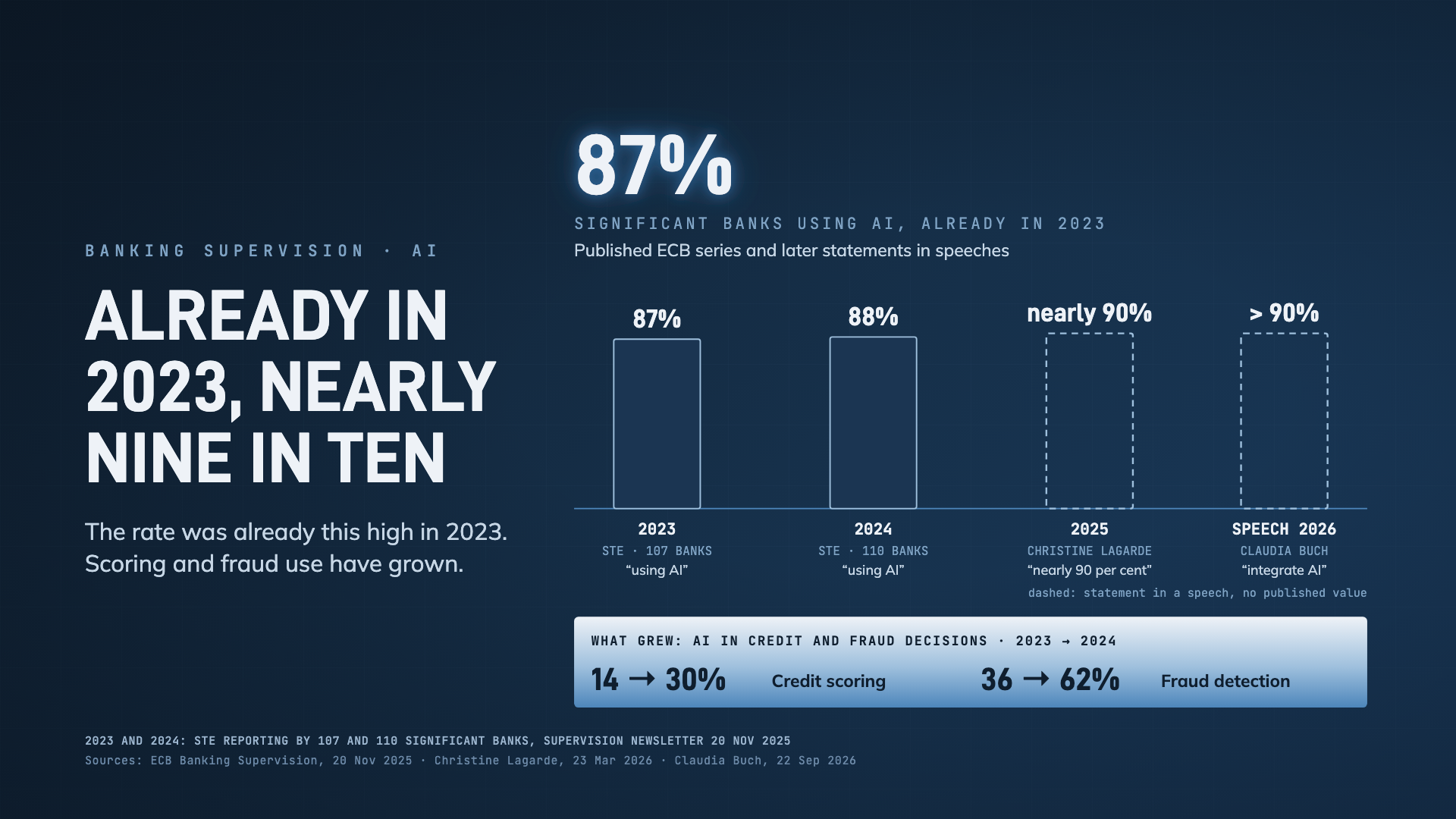
On 22 September Claudia Buch, who chairs the ECB’s Supervisory Board, said more than 90 per cent of directly supervised banks integrate AI into their operations. The supervisor’s published series already stood at 87 per cent in 2023. What has grown since is something else: the share of banks using AI in credit scoring rose from 14 to 30 per cent between 2023 and 2024, and in fraud detection from 36 to 62 per cent. My article sets out what the rate measures and why, for credit and fraud decisions, the supervisor names yardsticks other than the share of banks using AI.
90 per cent in operation: what the ECB’s AI figure measures and what it leaves open →
Agentic AI
tools, skills & what’s trending
Google gives every agent an identity and a spending cap
At Gemini at Work on 8 October Google presented what it calls a universal agent for work. According to Google Cloud chief executive Thomas Kurian, every agent gets its own cryptographically attested identity with least-privilege permissions, and every action is written to an audit trail attributed to the agent rather than to a person. All traffic runs through an Agent Gateway that enforces company policy in real time, and a hard spending cap per project pauses the agent. A preview is running for financial services and legal firms, with answers meant to carry confidence scores, data lineage and checkable sources. Microsoft is following suit: since 15 October it has been rolling out agent accounts through its Frontier early-access programme, letting agents work in Microsoft 365 under their own credentials. On 19 October it also announced that it will tie agents’ permissions to a running risk score that can require provable human approval before a consequential action, without saying when this will be available. What banks know as access recertification and the four-eyes principle now arrives as a product feature, but the policy itself still has to come from the bank.
Meta rents out the top of its range and opens the weights below it
On 12 October Meta introduced Muse Wonder and Muse Wonder Full, which it calls its most capable models to date, built for agentic tasks from an insurance claim to a lease. Muse Wonder is available through the Meta Model API and the Muse Code coding assistant, Muse Wonder Full only to Muse Code subscribers. According to VentureBeat, neither comes with downloadable weights, and Muse Wonder is priced at $4 per million input tokens and $20 per million output tokens on the API. Three days later, on 15 October, Meta released the weights of Muse Spark Open, which it describes as the most capable US open-weight model to date, with 816 billion parameters of which 42 billion are active per token. The weights are on Hugging Face, Amazon SageMaker, Google Cloud and Microsoft Foundry, though under Meta’s own licence with limited commercial terms. Banks that want a model in their own data centre therefore have a current Meta option, but the top of the range stays rented, and the licence needs legal review before any deployment.
Mistral brings forecasting models into the bank’s own data centre
Mistral released Timestral on 15 October, foundation models for time series in four sizes from 5 to 209 million parameters that run on ordinary processors and produce probability distributions rather than point forecasts. Mistral says its largest model ranks first on all three of the field’s main public benchmarks, GIFT-Eval, TIME and fev-bench, with two thirds of the parameters of the previous leader. It can run on premises, in a private cloud or fully air-gapped, under a modified MIT licence. Mistral explicitly cites finance teams as a use case, forecasting flows, volumes and volatility for positions, hedging and treasury. For liquidity management that is a tool that needs no client data to leave the building, although the benchmark results are the vendor’s own.
Banking & Regulation
what really matters now
ESMA is to supervise the big trading venues and clearing houses itself
On 9 October the Council of the EU agreed the key elements of its position on the Market Integration and Supervision Package (MISP), the centrepiece of the Savings and Investments Union. Supervision of the most significant cross-border trading venues and the most significant post-trade infrastructures, namely central securities depositories (CSDs) and central counterparties (CCPs), would move from national authorities to the European Securities and Markets Authority (ESMA). For crypto-asset service providers, the Council limits the switch at first to the most significant cross-border firms. ESMA would get an executive board of a chair and five independent full-time members, and the handover would run over two years. The Council points to an estimated €10 trillion of household savings held in low-yield bank deposits rather than in capital markets. Talks with Parliament can only start once it has a position of its own. Firms that run trading venues, clearing or custody are therefore likely to end up supervised by ESMA.
Hong Kong, London and Washington ask in one week about agents’ authority and kill switches
Carmen Chu, executive director for banking supervision at the Hong Kong Monetary Authority (HKMA), said on 16 October that more than 60 per cent of use cases in the second cohort of its generative AI sandbox involved AI agents. The HKMA organises its guidance around three pillars, accountability, resilience and trust, explicitly mentions kill switches that let banks suspend agents, is exploring whether a centralised supervisory registry could support this work, and has announced a discussion paper on agentic AI governance. Three days later Jessica Rusu, chief data, information and intelligence officer at the UK Financial Conduct Authority (FCA), said the FCA would work with industry, other regulators and frontier labs on a framework for agentic finance, with clear approaches to agent identity, delegated authority and accountability. She endorsed the UK AI minister’s view that near-miss reporting for agentic AI is a national security priority, adding that it is a regulatory priority too. Reuters, citing people who asked not to be named, reports that the Federal Reserve, the Office of the Comptroller of the Currency and the Federal Deposit Insurance Corporation are also questioning banks about their agents and how they would shut such systems down. The authority and kill switch of every agent therefore belong on file before the question appears in an examination report.
Signal & Noise
what deserves your time
- Global financial markets face rising risks from AI, bond yields and cyberattacks – Athanasios Vamvakidis and Jason Wu, IMF. The blog accompanying the Global Financial Stability Report counts 14 circular AI financing deals since 2023 with about $300 billion of equity and $650 billion of debt. In the stress scenario, banks holding 22 per cent of global banking assets would end up below regulatory capital limits, up from 18 per cent a year ago.
- One year to go to T+1 settlement – ESMA. The EU moves to T+1 on 11 October 2027, and with the revised guidelines and the amended technical standard on settlement discipline the rulebook is complete. The first deadline is 7 December 2026, when new allocation and confirmation requirements apply to investment firms and their clients.
- ESMA’s third sanctions report – ESMA. National authorities imposed more than 950 sanctions and measures and almost €82 million in fines in 2025, with Germany, France and Spain accounting for two thirds of the total across the European Economic Area.
- Letter on AI-enabled cybersecurity threats – ECB Banking Supervision. A reminder of the deadline: by 31 October every significant bank owes its Joint Supervisory Team an action plan against AI-enabled cyberattacks. The ECB will analyse the plans horizontally and share its conclusions with the banks.
- Visa, BILL and Billtrust Launch First Live Pilot for Trusted AI Agent Payments Between Buyer and Supplier Platforms – Visa. In the first live pilot, agents pay already approved invoices through supplier portals, authenticated via Visa’s Trusted Agent Protocol rather than shared logins. The decision to pay stays with the buyer, and the agent only executes what has been approved.
“The choice is not between halting progress and moving forward without guardrails. We must enable innovation and also demand responsibility.”
▸ Sources of this issue
- Citigroup Q3 2026 Earnings Call – Citi, transcript, 13 October 2026
- Bank of America Q3 2026 Earnings Call – Bank of America, transcript, 14 October 2026
- JPMorgan Chase Q3 2026 Earnings Call – JPMorgan Chase, transcript, 13 October 2026
- Wells Fargo Q3 2026 Earnings Call – Wells Fargo, transcript, 13 October 2026
- 90 per cent in operation: what the ECB’s AI figure measures and what it leaves open – the agentic banker, 14 October 2026
- Welcome to Gemini at Work 2026 – Thomas Kurian, Google Cloud, 8 October 2026
- Delegate shared business processes to agents with Microsoft Copilot Studio – Microsoft, 15 October 2026
- Agents are your newest insiders – Microsoft Security, 19 October 2026
- Introducing Muse Wonder – Meta, 12 October 2026
- Meta’s new Muse Wonder and Muse Wonder Full models – VentureBeat, 12 October 2026
- Introducing Muse Spark Open – Meta, 15 October 2026
- Timestral – Mistral AI, 15 October 2026
- Savings and investments union: Council agrees key elements of crucial measures to deepen EU capital markets – Council of the EU, 9 October 2026
- Speech at the Finance + A.I. Forum – Carmen Chu, HKMA, 16 October 2026
- Building the future of finance in the age of AI – Jessica Rusu, FCA, 19 October 2026
- Banking watchdogs ramp up AI scrutiny as stability fears mount – Reuters, 13 October 2026
- Global financial markets face rising risks from AI, bond yields and cyberattacks – Athanasios Vamvakidis, Jason Wu, IMF, 13 October 2026
- One year to go to T+1 settlement – ESMA, 16 October 2026
- ESMA’s third sanctions report – ESMA, 15 October 2026
- Letter on AI-enabled cybersecurity threats – ECB Banking Supervision, 7 July 2026
- Visa, BILL and Billtrust Launch First Live Pilot for Trusted AI Agent Payments Between Buyer and Supplier Platforms – Visa, 20 October 2026
- Goldman Sachs Q3 2026 Earnings Call – Goldman Sachs, transcript, 13 October 2026