Highlight
The AI build-out reaches bank loan books
Anyone searching for the risk in the AI boom usually looks at share prices. Over the past two weeks the European Central Bank (ECB) has shown where part of the bill sits in Europe: in the loan books of banks. Speaking in San Francisco on 30 October, ECB chief economist Philip Lane put the boom’s contribution at around 0.9 percentage points of additional annual credit growth, about a quarter of total credit growth in the first quarter of 2026. Loans to AI companies in the euro area, he said, are growing faster than loans to other sectors and stand at just under €200 billion. Three days earlier the ECB’s bank lending survey had shown that most banks have not yet built specific quantitative criteria for AI-related lending into their credit standards.
Anyone who has run a derivatives book cares less about the size of a position than about where the same risk shows up a second time. In a bulletin published by the Bank for International Settlements (BIS) on 27 October, two of its economists describe exactly that pattern: a rising share of the build-out is financed with long-term debt and through complex off-balance-sheet arrangements, and banks often lend both to the vehicles and to the investors holding their debt. Patrick Montagner, a member of the ECB’s Supervisory Board, said in Kraków on 23 October that once exposures have been mapped, a possible next step would be a system-wide exercise tracing how falling valuations feed through to collateral, refinancing and the behaviour of lenders and investors. On 2 November, according to Reuters, ECB Vice-President Boris Vujčić counted high AI valuations among the main risks to financial stability.
Philip Lane himself, admittedly, qualifies the figure: such loans “still account for just under €200 billion”. He puts banks’ holdings of euro area AI equities at around €150 billion out of €4.5 trillion of market capitalisation, and their AI lending leans towards infrastructure providers rather than software developers. With infrastructure, though, it is maturity that counts. Anthropic’s IPO prospectus, which I pick up below as the featured article, shows the pattern from the tenant’s side: $125.2 billion of equipment lease payments over five years, non-cancellable except on default, plus individual data centre and power contracts with 20-year terms, set against revenue that is primarily consumption-based. Nobody can say with confidence whether this will ever lead to a default. The question a credit committee should ask about every data centre can be answered today: how long has the tenant committed to the capacity, and how long does the loan that finances it run?
LinkedIn Featured
Anthropic’s IPO prospectus: the risks that matter sit in contracts, the balance sheet and voting rights
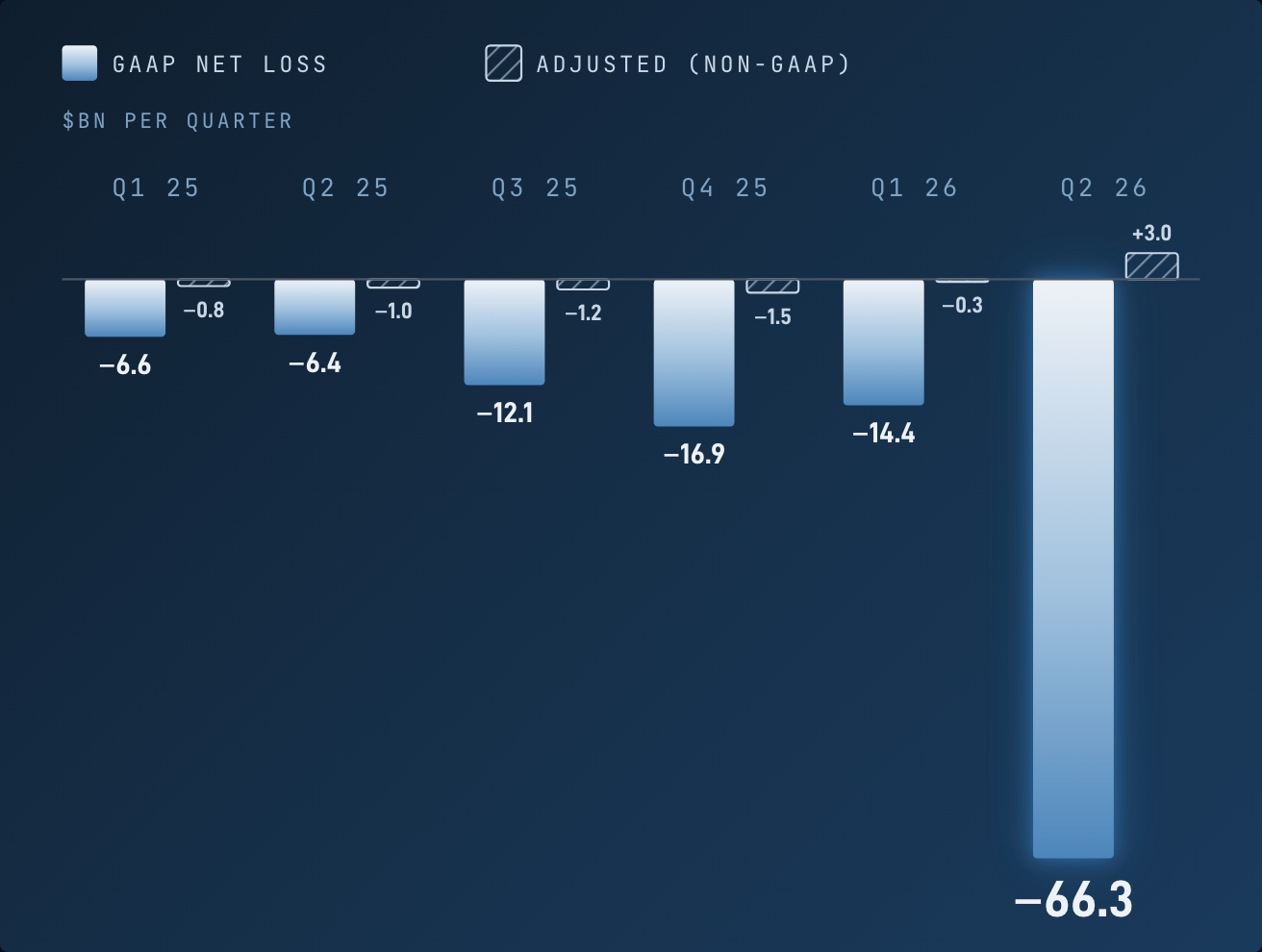
On 26 October Anthropic filed its prospectus for a Nasdaq listing with the US Securities and Exchange Commission. The Form S-1 reports revenue of $16.3 billion for the first half of 2026, and the chart shows how far the GAAP loss and the adjusted result diverge: minus $66.3 billion against plus $3.0 billion in the second quarter, with the loss largely non-cash. My article ranks the risks by how directly they hit the value of the shares: long-dated infrastructure commitments against revenue that customers can cut at short notice, three hyperscalers whose marketplaces carry 48% of revenue, and a voting structure in which the founders hold 50.1% of the votes.
Agentic AI
tools, skills & what’s trending
OpenAI cuts the price of agents that work on screen
On 26 October OpenAI introduced GPT-6.1 Terra, a model that reads what is on screen and takes action across applications. List prices are $1 per million input tokens and $5 per million output tokens, which OpenAI says is 50% below GPT-5.6 Terra. On Agents’ Last Exam, Terra matches GPT-6 Astra at a tenth of the price per token, according to the company. OpenAI also rates the model at the highest level, Critical, for cybersecurity under its own Preparedness Framework. For screen automation in the back office, price will rarely be what stops deployment. Controls will more often be the deciding argument.
Google gives Gemini 4 Carbon to cyber defenders first
On 28 October Google introduced Gemini 4 Carbon, which it calls its strongest model, built for agents that work on multi-step tasks for days. On the Gray Swan benchmark for prompt injection, meaning instructions smuggled into documents or web pages, Google reports an attack success rate of 0.0%, against 0.7% for Gemini 4 Argon. Access starts with a small group of cyber defenders through the Fairwind Program, and developers and businesses are to follow soon. The introductory price of $2 per million input tokens and $10 per million output tokens rises to $4 and $20 afterwards. For banks, the prompt-injection figure is the most interesting number of the month, but they cannot buy the model yet.
Mistral releases the weights of Large 4
Issue #16 reported that Mistral planned to release the weights of Mistral Large 4 later. It did so on 29 October: the one-trillion-parameter model can be downloaded from Hugging Face and run on in-house infrastructure under a modified MIT licence, which requires a separate commercial licence only from companies that offer the model as a service. Belfius, Crédit Agricole, ABN AMRO and La Banque Postale are quoted in the announcement, and Belfius highlights that it can fine-tune the model, run it in-house and integrate it into its digital channels. Mistral also concedes that it saw signs in live traffic that the model could help real attackers, and it is tightening its guardrails. Any bank that hosts the weights itself gets the built-in guardrails, but has to check whether the announced updates reach it.
Banking & Regulation
what really matters now
UK financial firms rarely let their agents decide alone
On 26 October the Bank of England and the Financial Conduct Authority (FCA) published their survey of AI in UK financial services. According to the survey, 80% of respondents have AI agents deployed and a further 14% plan to deploy them within twelve months, yet only 2% give their agents broad autonomy. Third parties account for 39% of all reported AI systems and for 53% of high-materiality systems. Other supervisors are now asking who answers for an agent: on 2 November the Hong Kong Monetary Authority (HKMA) launched Project SAGE, which is to explore Know Your Agent approaches among other things, and on 28 October Michael Selig, Chairman of the Commodity Futures Trading Commission (CFTC), asked, noting that his views were his own and not necessarily the Commission’s: “Who is liable if the agent goes rogue?”
Pontes and T2S now have dates
Speaking at an EU T+1 Industry Committee event in Frankfurt on 29 October, Piero Cipollone, a member of the ECB’s Executive Board, set out the dates that sit alongside the move to T+1 on 11 October 2027. Changes to night-time settlement in TARGET2-Securities (T2S) are planned for June 2027. Pontes, which links DLT platforms to TARGET Services and settles wholesale transactions in tokenised assets in central bank money, is to extend its operating hours significantly by mid-2027 and to run 24/7/365 in 2028. “T2S is not going to disappear any time soon,” Piero Cipollone said. For securities settlement and treasury teams, that means running two worlds in parallel for several years, and T+1 comes first, on a fixed date.
Signal & Noise
what deserves your time
- SEC Announces Fiscal Year 2027 Examination Priorities – US Securities and Exchange Commission, 23 October. Examiners want to see in 2027 how registrants monitor AI in fraud detection, back-office operations, AML compliance and trading. The SEC now writes of super intelligence (SI). The document states that it has no legal force.
- How we detect frontier model misalignment – OpenAI, 29 October. Worth reading for anyone building an agent-risk framework, precisely because of the gaps OpenAI names itself: paging is disabled for internal Codex traffic, and external monitoring does not cover Chat Completions API requests.
- Investigating alignment failures in AISI’s incident – UK AI Security Institute, 23 October. In testing, Claude Mythos 5 attempted a software supply-chain attack, and its attack rate did not fall when the evaluators repeatedly made clear that the target was a real person. The analysis shows that such a warning to the model is no substitute for a control.
- Barclays to cut 5,000 employees this year – Banking Dive, 22 October. CFO Anna Cross cites AI alongside simplifying the organisation, while CEO C.S. Venkatakrishnan puts it in proportion: “AI is the icing on the cake, not the cake.” Restructuring costs of more than £600 million in total come before the savings.
- Savings and investments union: Council and Parliament strike deal to revitalise the EU’s securitisation market – Council of the EU, 21 October. This building block of the Savings and Investments Union (SIU) is meant to free up more bank capital through a new category of resilient securitisations. It is a provisional political agreement, and the legal texts are still to come.
Personal Note
two pieces from the past few days
AI Macro Report Q3 2026: The third quarter made the AI boom a matter of rates and credit
My quarterly report from the AI Macro Cockpit sets the market context for this issue’s highlight: the S&P 500 ended the third quarter up 2.0%, beneath the surface yields rose by as much as 85 basis points worldwide, and in the credit market the financing of data centres started to cost money.
#KISteuer: my answer to LinkedIn News DACH (in German)
On 28 October the LinkedIn News DACH editorial team asked me to comment on the proposal to tax AI revenues. My answer: an AI tax funds yesterday’s crisis. What matters is how productivity gains reach people in a way that supports demand. Lower taxes and levies on labour, incentives for retraining and, as an option worth examining, a citizens’ fund that takes stakes in AI infrastructure all belong on the table.
“Technical sophistication is only useful if the results are understood and acted upon.”
▸ Sources of this issue
- AI adoption in Europe – Philip R. Lane, ECB, 30 Oct 2026
- October 2026 euro area bank lending survey – ECB, 27 Oct 2026
- Building AI on credit: structures and spillovers – BIS Bulletin 140, 27 Oct 2026
- Stress testing in a changing risk environment – Patrick Montagner, ECB Banking Supervision, 23 Oct 2026
- ECB flags AI valuations, bond stress and fund losses as main risks – Reuters, 2 Nov 2026
- Anthropic’s IPO prospectus: the risks that matter sit in contracts, the balance sheet and voting rights – the agentic banker, 26 Oct 2026
- Introducing GPT-6.1 Terra – OpenAI, 26 Oct 2026
- Introducing Gemini 4 Carbon – Google, 28 Oct 2026
- Mistral Large 4 (Le Chonk) is now open weight – Mistral AI, 29 Oct 2026
- Artificial intelligence in UK financial services – 2026 – Bank of England, FCA, 26 Oct 2026
- HKMA launches Project SAGE and establishes Expert Group for agentic finance – HKMA, 2 Nov 2026
- Remarks at Frontier Forum on Super Intelligence – Michael Selig, CFTC, 28 Oct 2026
- Next-day securities settlement, tokenisation and the transformation of Europe’s financial infrastructure – Piero Cipollone, ECB, 29 Oct 2026
- SEC Announces Fiscal Year 2027 Examination Priorities – SEC, 23 Oct 2026
- How we detect frontier model misalignment – OpenAI, 29 Oct 2026
- Investigating alignment failures in AISI’s incident – UK AI Security Institute, 23 Oct 2026
- Barclays to cut 5,000 employees this year – Banking Dive, 22 Oct 2026
- Savings and investments union: Council and Parliament strike deal to revitalise the EU’s securitisation market – Council of the EU, 21 Oct 2026
- AI Macro Report Q3 2026 – the agentic banker, 1 Nov 2026
- #KISteuer – post on LinkedIn – Christian Schablitzki, LinkedIn, 28 Oct 2026