Highlight
AI agents want access to the customer account
Speaking in Milan on 16 November, Michael Barr, a Governor of the US Federal Reserve (Fed), named a new risk: major banks are finding AI agents attempting to take actions in retail customer accounts, without the bank being able to verify authenticity, consent and alignment with the customer’s instructions. Three days earlier OpenAI had introduced ChatGPT Wallet, which lets an agent pay on its user’s behalf. The payment network supplies a payment token in place of the real card details, every purchase requires a security check, and the service was built with American Express, Chase, Mastercard and Visa, initially only for Pro subscribers in the US. Anthropic draws the line elsewhere with Personal Finance in Claude: Claude reads accounts through the data provider Plaid but cannot move money. The agents are reaching payments and accounts, and the open question is who sets their limits once they get there.
Anyone who has been responsible for trading limits knows that a limit is only as good as the point where it bites. On the bank side, that point is often missing even for banks’ own agents. The Boston Consulting Group (BCG) benchmarked 26 global and domestic systemically important banks and published the results on 13 November: 73% permit agents in production for selected uses, but only 8% have a comprehensive, standardised monitoring and control framework that explicitly covers agents. Michael Barr calls for strict authentication, explicit consent verification for specific actions and technical controls on what an agent can do. For now, banks fall back on blocking: according to Reuters, most of them stop external agents from authorising transactions within their systems. I doubt customers will accept that for long. In a McKinsey survey of 46,000 retail banking customers, 72% of AI users said they would let a banking agent carry out a financial task, although most would cap autonomous approvals at $500.
Providers are, admittedly, building the first controls themselves: OpenAI’s token and security check are exactly that, and Chase is one of its partners. But those controls work at the level of the agent and the card payment, and Michael Barr describes the problem from the other side: the bank sees an action in the account and cannot verify that the customer wanted it. JPMorgan’s work with Hyundai Card shows what the bank side can look like. In a first test on the blockchain platform Kinexys, a Hyundai Card agent requested a simulated foreign exchange transaction to maintain euro liquidity in its account, handled between the bank’s agent and the client’s. Wee Kee Toh of Kinexys describes the principle: “You are going to draw a box around the agent.” An agent with a $5 million limit cannot execute anything above it. According to Wee Kee Toh, the harder work lay in governance and internal controls, while the technology itself was relatively straightforward. Most banks can already block outside agents. What they lack are controls that let them in without giving up the consent check. The question for every bank is where its own box sits before the first outside agent tries to act in an account.
LinkedIn Featured
Crypto trading in the Sparkassen app: Deka is the counterparty
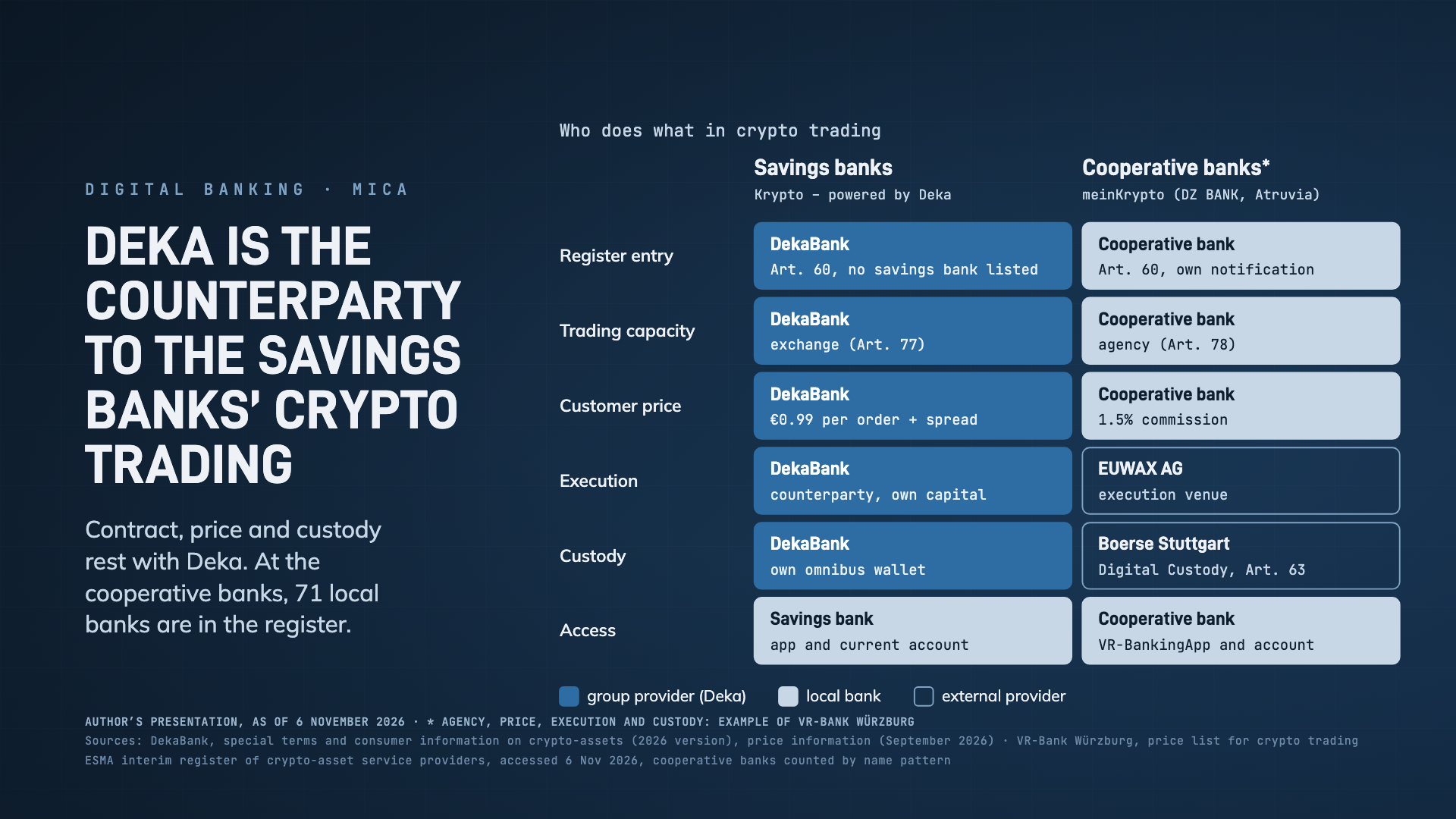
Since 19 October, customers of the first German savings banks have been able to trade Bitcoin, Ethereum, Solana, XRP and Polygon in the Sparkassen app for €0.99 per order plus a spread. Coverage of the launch read it as the savings banks entering the crypto market. In legal terms, the entrant is DekaBank: it signs the contract, trades the crypto-assets directly with the customer using its own capital and holds them in custody. Not a single savings bank appears in the register of the European Securities and Markets Authority (ESMA), whereas 71 cooperative banks have notified the execution of orders themselves. The chart sets the two designs side by side. For retail banking boards, the design determines who sets the price, who carries the obligations under the Markets in Crypto-Assets Regulation (MiCA) and who holds the customer contract.
Crypto trading in the Sparkassen app: Deka is the counterparty →
Agentic AI
tools, skills & what’s trending
OpenAI measures GPT-6.2 Astra by cost per task
On 17 November OpenAI introduced GPT-6.2 Astra and GPT-6.2 Sol. On Agents’ Last Exam, Astra scores 5.5 points ahead of Claude Fable 5.2 at 5% of the cost, according to the company. Astra and Fable 5.2 carry the same list prices, $8 per million input tokens and $40 per million output tokens, so the gap comes mainly from how much each consumes per task. A footnote from OpenAI itself qualifies the comparison: nine Fable 5.2 tasks that ran on a fallback model are excluded. For model selection in banking workflows, what counts is the cost per completed task on a bank’s own cases, and a price list per token no longer settles that.
Microsoft gives outside agents an identity too
At Ignite on 17 November, Microsoft reported that organisations have registered more than 50 million agents in Microsoft Agent 365 since its launch in May 2026. Agents from Google, Salesforce, Databricks, Snowflake, Anthropic and OpenAI are now gradually getting their own identity in Microsoft Entra, so that IT and security teams can govern them alongside Microsoft’s own agents. Microsoft frames the questions explicitly: who owns each agent, what risk it carries and what it costs. For a bank, this is the inventory that BCG found missing at more than half of the institutions it studied, a centralised, tool-based register of AI systems.
Anthropic puts a number on how often Mythos reaches outside its sandbox
On 9 November Anthropic introduced Claude Fable 5.2 and Claude Mythos 5.2, priced at $8 per million input tokens and $40 per million output tokens. In tests where the sandbox had a deliberate weakness, Mythos 5.2 used credentials or files placed outside its sandbox in 3.1% of scenarios, down from 39% and 21% for Mythos 5 and 5.1. Mythos 5.2 remains limited to vetted organisations, while Fable 5.2 is available on all platforms, including AWS, Google Cloud and Microsoft Azure. For a bank’s model risk documentation, a published rate like this is more useful than any assurance, and it also shows that a sandbox on its own is not yet a control.
Banking & Regulation
what really matters now
BaFin announces shorter, more targeted cyber inspections
Speaking at Bitkom’s Digital Finance Conference in Berlin on 10 November, Mark Branson, President of Germany’s Federal Financial Supervisory Authority (BaFin), said that almost 900 IT incidents had been reported to the supervisor over the past four quarters, 14% of them caused by attacks. BaFin is expanding its cyber security department and plans shorter, highly targeted inspections in that area. Since July it has been the market surveillance authority for AI systems in the financial sector, checking for prohibited practices, transparency obligations and staff AI literacy, with the requirements for high-risk AI added from December 2027. For powerful and agentic models, Mark Branson points first to the requirements of the Digital Operational Resilience Act (DORA). BaFin recommends that particularly critical systems move to quantum-resistant encryption by 2030, and the industry, in his words, needs more sovereign infrastructure that reduces dependence on hyperscalers based outside the EU.
The largest US banks have close to $1 trillion of exposure to tech firms and data centres
The Fed’s November Financial Stability Report puts the exposure of the largest US bank holding companies to large technology firms, data centre developers, advanced computing-related special purpose entities and private credit vehicles, and utilities, at close to $1 trillion, evaluated in the annual supervisory stress test. The Fed estimates outstanding public debt related to advanced computing, that is, debt issued in public markets, at more than $1.1 trillion as of October 2026. The technology firms’ other obligations are growing faster than their debt: not-yet-commenced leases with undiscounted values above $1 trillion, and further commitments such as take-or-pay contracts and residual value guarantees above $2 trillion. Issue #18 showed the credit side in the euro area at just under €200 billion. The Fed and ECB figures are only partly comparable, because the Fed’s measure also covers large technology firms and utilities alongside data centres.
Signal & Noise
what deserves your time
- Banks seek to rein in soaring AI agent costs, McKinsey says – Reuters, 10 November. Token spending could easily reach 20% of a bank’s total labour costs, according to McKinsey, and some banks have handed control to teams they call AI FinOps. Vik Sohoni explains why routing queries to cheaper models stops working once agents talk to each other.
- Why Operationalizing Governance Gives Banks an Advantage in Scaling AI – Boston Consulting Group, 13 November. The data behind this issue’s highlight: banks in the top third for risk management maturity were 2.5 times as likely to be advanced AI adopters as those in the bottom third. No institution reports a human-oversight framework implemented consistently across its AI systems.
- JPMorgan is working on AI agent transactions that don’t involve humans – CNBC, 17 November. The test is still a test, and JPMorgan has set no timeline for a product. A more complex phase involving several interacting agents is planned for the first half of 2027, and that is where the box will have to hold between them.
- Decoding the cyber-AI nexus – ECB, Financial Stability Review November 2026. Around one-fifth of cyber incidents affecting euro area banks originate from third-party providers, according to the European Central Bank (ECB). In a European Banking Authority survey, 56% of banks faced no attack in the first half of 2026 that caused or could have caused a major information and communication technology (ICT) incident, up from 49% in the previous half. At the same time, 11% saw 11 or more attacks, up from 7%, which the ECB reads as a possible early sign of a bifurcation between banks.
- Financial institutions accelerate transition to multi-agent AI in drive for bottom-line value – Capgemini, 5 November. Of the financial institutions surveyed, 59% are piloting or deploying multi-agent systems, but only 10% orchestrate them across the enterprise. Among banks and insurers, 52% pick hyperscalers as their preferred cloud partner for governing them, a figure worth reading next to Mark Branson’s call for more sovereign infrastructure.
Personal Note
the agentic banker on Substack
I read the AI trade after every US close
Since 5 November I have been writing about the AI trade in financial markets on Substack. After each US close I set out what moved AI stocks, chipmakers and rates, and whether the previous day’s reading held, drawing on some 20 years as an investment banker and derivatives trader. If that perspective interests you, follow me there. The Daily is free.
“Now is not the time for naivety. If only a fraction of the gigantic investment in AI capacity were spent on cyber security, the financial world would be a much safer place.”
▸ Sources of this issue
- Some Potential Financial Stability Implications of Artificial Intelligence – Michael S. Barr, Federal Reserve, 16 Nov 2026
- Introducing ChatGPT Wallet – OpenAI, 13 Nov 2026
- Introducing Personal Finance in Claude – Anthropic, Nov 2026
- Why Operationalizing Governance Gives Banks an Advantage in Scaling AI – Boston Consulting Group, 13 Nov 2026
- Banks seek to rein in soaring AI agent costs, McKinsey says – Reuters, 10 Nov 2026
- JPMorgan is working on AI agent transactions that don’t involve humans – CNBC, 17 Nov 2026
- Crypto trading in the Sparkassen app: Deka is the counterparty – the agentic banker, 11 Nov 2026
- Introducing GPT-6.2 Astra and Sol – OpenAI, 17 Nov 2026
- What’s new in Microsoft Agent 365: Ignite 2026 – Microsoft, 17 Nov 2026
- Claude Fable 5.2 and Mythos 5.2 – Anthropic, 9 Nov 2026
- „Jetzt ist nicht die Zeit für Naivität“ – Mark Branson, BaFin, 10 Nov 2026
- Financial Stability Report, November 2026 – Federal Reserve, Nov 2026
- Decoding the cyber-AI nexus – ECB, Financial Stability Review, Nov 2026
- Financial institutions accelerate transition to multi-agent AI in drive for bottom-line value – Capgemini, 5 Nov 2026
- the agentic banker on Substack – Christian Schablitzki